According to SPER Market Research, the Global Hafnium Carbide Market is estimated to reach USD 462.72 Million by 2034 with a CAGR of 8.75%.
Introduction and Overview
In 2024, the hafnium carbide market was projected to be worth USD 200 million worldwide. The market is anticipated to expand at a compound annual growth rate (CAGR) of 8.75% between 2025 and 2034. The global hafnium carbide market is experiencing strong growth due to rising demand from high-performance industries. Known for its exceptional thermal and chemical stability, hafnium carbide is increasingly used in applications requiring resistance to extreme conditions. Its ultra-high melting point, excellent hardness, and reliable thermal conductivity make it ideal for advanced uses. The aerospace and defense sectors extensively utilize hafnium carbide in rocket nozzles, turbine blades, and hypersonic vehicle thermal protection systems, where its ability to withstand intense heat and stress supports continued technological advancement and market expansion.
By Product Type Insights
The market for hafnium carbide is mainly divided into three product types: powder, sputtering targets, granules, and other specialised forms. Powder has become the most popular product type because of its broad range of applications and processing flexibility. Because it enables accurate control over material characteristics and effective sintering, hafnium carbide powder is widely utilised in ultra-high-temperature ceramics, thermal barrier coatings, additive manufacturing, and aerospace components. Because of its adaptability, it is the best option for industrial, defence, and research applications.
By Purity Insights
The market for hafnium carbide by purity level is usually divided into a number of classes that represent the material's hafnium carbide concentration and have a direct impact on how well it performs in various applications. Because of its superior thermal stability, oxidation resistance, and dependability in demanding industries like aerospace, defence, semiconductors, and advanced manufacturing, the above 99.5% purity segment typically dominates market demand. High-purity hafnium carbide is particularly useful for mission-critical components and high-tech applications because it guarantees minimum impurities that could impair performance in harsh environments.
By Application Insights
The market for hafnium carbide by application encompasses a variety of high-performance industries that take advantage of the material's remarkable qualities, including its ultra-high melting point, thermal stability, hardness, and chemical resistance. Due to the necessity for materials that can tolerate high temperatures and mechanical stresses in turbine components, rocket nozzles, thermal protection systems, and hypersonic flight vehicles, aerospace and defence make up the largest application area in the majority of industry publications.
Regional Insights
North America's robust aerospace, defence, and sophisticated manufacturing industries make it a major hafnium carbide market. Due to significant investments in space exploration, defence modernisation, and hypersonic vehicles—all of which call for ultra-high-temperature materials like HfC—the United States, in particular, dominates. The manufacturing of powders, sputtering targets, and speciality ceramics that satisfy strict industry standards is made possible by the region's well-established supply chains, access to high-purity hafnium sources, and sophisticated R&D skills.
Market Competitive Landscape
The hafnium carbide market is characterised by a moderately concentrated structure with a small number of specialised global and regional companies, Because of the high entry hurdles and technological difficulty involved in creating ultra-high-temperature materials. Because end-use sectors like aerospace, defence, electronics, and nuclear energy require materials that continuously function under harsh conditions, the main factors driving competition are product purity, performance reliability, customisation capabilities, and technological competence. Leading businesses put a lot of effort into research and development to enhance powder morphology, raise purity levels, and create application-specific solutions. To secure long-term contracts and speed up innovation, strategic partnerships with defence agencies, research institutions, and aerospace manufacturers are becoming more common.
Recent Developments:
• In March 2025, Pacific Particulate Materials revealed that it had made several strategic partnerships to distribute its hafnium carbide products exclusively in Asia and North America.
• In January 2025, Nanografi Advanced Materials introduced a new line of hafnium carbide powders specifically designed for semiconductor applications.
Scope of the report:
Report Metric Details
Market size available for the years 2021-2034
Base year considered 2024
Forecast Period 2025-2034
Segments Covered By Product Type, By Purity, By Application
Regions Covered North America, Latin America, Asia-Pacific, Europe, and Middle East & Africa
Companies Covered American Elements, Ereztech, Hunan Huawei Jingcheng Material Technology, Merck, Nanografi Advanced Materials, Otto Chemie, Pacific Particulate Materials, Stanford Advanced Materials, Starsky International Holdings
Key Topics Covered in the Report
• Global Hafnium Carbide Market Size (FY’2021-FY’2034)
• Overview of Global Hafnium Carbide Market
• Segmentation of Global Hafnium Carbide Market by Product Type (Powder, Sputtering target, Granules)
• Segmentation of Global Hafnium Carbide Market by Purity (Less than 99%, 99%–99.5%, Above 99.5%)
• Segmentation of Global Hafnium Carbide Market by Application (Aerospace and defense, Ceramic, Electronics and semiconductor, Nuclear energy, Industrial)
• Statistical Snap of Global Hafnium Carbide Market
• Expansion Analysis of Global Hafnium Carbide Market
• Problems and Obstacles in Global Hafnium Carbide Market
• Competitive Landscape in the Global Hafnium Carbide Market
• Details on Current Investment in Global Hafnium Carbide Market
• Competitive Analysis of Global Hafnium Carbide Market
• Prominent Players in the Global Hafnium Carbide Market
• SWOT Analysis of Global Hafnium Carbide Market
• Global Hafnium Carbide Market Future Outlook and Projections (FY’2025-FY’2034)
• Recommendations from Analyst
Global Hafnium Carbide Market Size- By Product Type, By Purity, By Application – Regional Outlook, Competitive Strategies and Segment Forecast to 2034
1. Introduction
1.1. Scope of the report
1.2. Market segment analysis
2. Research Methodology
2.1. Research data source
2.1.1. Secondary Data
2.1.2. Primary Data
2.1.3. SPER’s internal database
2.1.4. Premium insight from KOL’s
2.2. Market size estimation
2.2.1. Top-down and Bottom-up approach
2.3. Data triangulation
3. Executive Summary
4. Market Dynamics
4.1. Driver, Restraint, Opportunity and Challenges analysis
4.1.1. Drivers
4.1.2. Restraints
4.1.3. Opportunities
4.1.4. Challenges
5. Market variable and outlook
5.1. SWOT Analysis
5.1.1. Strengths
5.1.2. Weaknesses
5.1.3. Opportunities
5.1.4. Threats
5.2. PESTEL Analysis
5.2.1. Political Landscape
5.2.2. Economic Landscape
5.2.3. Social Landscape
5.2.4. Technological Landscape
5.2.5. Environmental Landscape
5.2.6. Legal Landscape
5.3. PORTER’s Five Forces
5.3.1. Bargaining power of suppliers
5.3.2. Bargaining power of buyers
5.3.3. Threat of Substitute
5.3.4. Threat of new entrant
5.3.5. Competitive rivalry
5.4. Heat Map Analysis
6. Competitive Landscape
6.1. Global Hafnium Carbide Market Manufacturing Base Distribution, Sales Area, Product Type
6.2. Mergers & Acquisitions, Partnerships, Product Launch, and Collaboration in Global Hafnium Carbide Market
7. Global Hafnium Carbide Market, By Product Type (USD Million) 2021-2034
7.1. Powder
7.2. Sputtering target
7.3. Granules
7.4. Others
8. Global Hafnium Carbide Market, By Purity (USD Million) 2021-2034
8.1. Less than 99%
8.2. 99% - 99.5%
8.3. Above 99.5%
9. Global Hafnium Carbide Market, By Application (USD Million) 2021-2034
9.1. Aerospace and defense
9.2. Ceramic
9.3. Electronics and semiconductor
9.4. Nuclear energy
9.5. Industrial
9.6. Others
10. Global Hafnium Carbide Market, By Region, (USD Million) 2021-2034
10.1. Asia-Pacific
10.1.1. Australia
10.1.2. China
10.1.3. India
10.1.4. Japan
10.1.5. South Korea
10.1.6. Rest of Asia-Pacific
10.2. Europe
10.2.1. France
10.2.2. Germany
10.2.3. Italy
10.2.4. Spain
10.2.5. United Kingdom
10.2.6. Rest of Europe
10.3. Middle East and Africa
10.3.1. Kingdom of Saudi Arabia
10.3.2. United Arab Emirates
10.3.3. Qatar
10.3.4. South Africa
10.3.5. Egypt
10.3.6. Morocco
10.3.7. Nigeria
10.3.8. Rest of Middle-East and Africa
10.4. North America
10.4.1. Canada
10.4.2. Mexico
10.4.3. United States
10.5. Latin America
10.5.1. Argentina
10.5.2. Brazil
10.5.3. Rest of Latin America
11. Company Profile
11.1. American Elements
11.1.1. Company details
11.1.2. Financial outlook
11.1.3. Product summary
11.1.4. Recent developments
11.2. Ereztech
11.2.1. Company details
11.2.2. Financial outlook
11.2.3. Product summary
11.2.4. Recent developments
11.3. Hunan Huawei Jingcheng Material Technology
11.3.1. Company details
11.3.2. Financial outlook
11.3.3. Product summary
11.3.4. Recent developments
11.4. Merck
11.4.1. Company details
11.4.2. Financial outlook
11.4.3. Product summary
11.4.4. Recent developments
11.5. Nanografi Advanced Materials
11.5.1. Company details
11.5.2. Financial outlook
11.5.3. Product summary
11.5.4. Recent developments
11.6. Otto Chemie
11.6.1. Company details
11.6.2. Financial outlook
11.6.3. Product summary
11.6.4. Recent developments
11.7. Pacific Particulate Materials
11.7.1. Company details
11.7.2. Financial outlook
11.7.3. Product summary
11.7.4. Recent developments
11.8. Stanford Advanced Materials
11.8.1. Company details
11.8.2. Financial outlook
11.8.3. Product summary
11.8.4. Recent developments
11.9. Starsky International Holdings
11.9.1. Company details
11.9.2. Financial outlook
11.9.3. Product summary
11.9.4. Recent developments
11.10. Others
12. Conclusion
13. List of Abbreviations
14. Reference Links
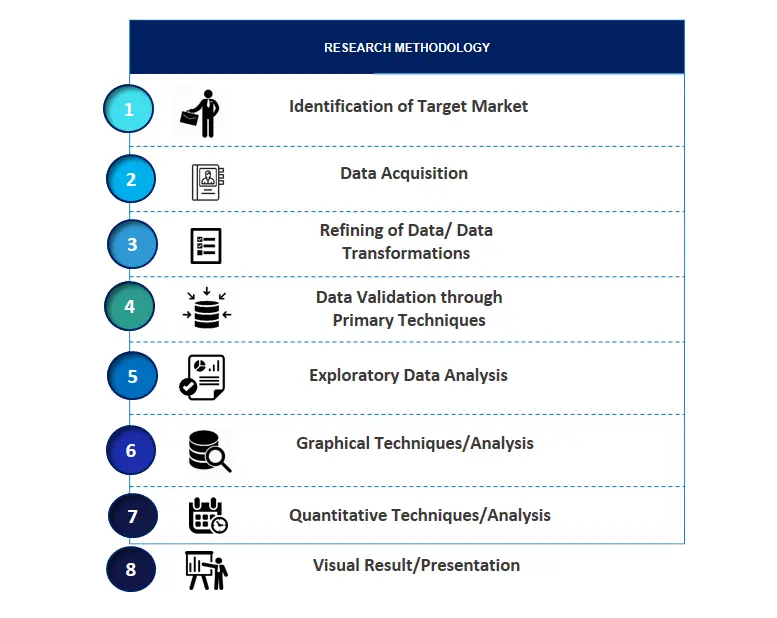
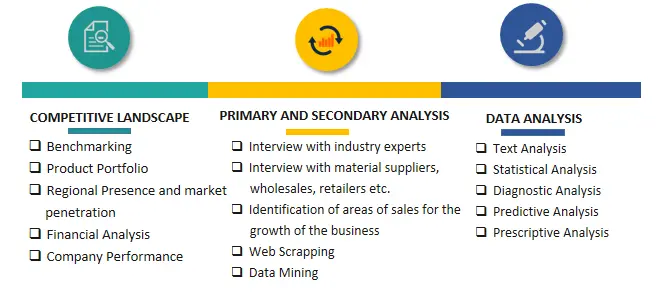
SPER Market Research’s methodology uses great emphasis on primary research to ensure that the market intelligence insights are up to date, reliable and accurate. Primary interviews are done with players involved in each phase of a supply chain to analyze the market forecasting. The secondary research method is used to help you fully understand how the future markets and the spending patterns look likes.
The report is based on in-depth qualitative and quantitative analysis of the Product Market. The quantitative analysis involves the application of various projection and sampling techniques. The qualitative analysis involves primary interviews, surveys, and vendor briefings. The data gathered as a result of these processes are validated through experts opinion. Our research methodology entails an ideal mixture of primary and secondary initiatives.